

If your horse feels completely different from one direction to the other, you’re not imagining it! One-sided stiffness is something horse owners notice all the time. For example, horses can bend easily to the left but struggle to the right, feel heavier in one rein, fall in through a shoulder, or have a harder time maintaining the same balance and rhythm on both sides.
Some degree of asymmetry is normal. Horses, like people, have movement preferences, stronger areas, weaker areas, and habits that develop over time. I pay closer attention to how pronounced that difference is, whether it is changing, and whether other signs suggest the horse is uncomfortable rather than simply less coordinated in one direction.
One-sided stiffness can involve strength, muscle tension, compensation, tack, the rider, or discomfort elsewhere in the body. Often, more than one of those things is involved.
What One-Sided Stiffness Can Look Like
When riders tell me their horse is “stiff on one side,” they can be describing several different things.
The horse usually has more difficulty bending in one direction, feels heavier on one rein, or struggles to stay on the same-size circle in both directions. Transitions may feel different from side to side. One canter lead may be more difficult. Some horses feel less coordinated turning one way or consistently choose to stand or move in a particular position.
Owners notice differences on the ground, too. During grooming or bodywork, one side of the neck, shoulder, back, or hindquarters may feel different beneath your hands. Your horse might be comfortable turning their head toward one side but reluctant to do the same thing in the other direction.
None of those observations tells us, by itself, what is causing the stiffness. They do give us useful information about how the horse is currently using their body.
Are Horses Naturally Stiffer on One Side?
Most horses are not perfectly symmetrical, and expecting them to move exactly the same way in both directions isn’t realistic.
Training, posture, previous workload, conformation, strength, coordination, old injuries, and simple movement habits can all contribute to a horse developing a preferred side.
That is why I tend to look at changes rather than expecting perfect symmetry.
If your horse has always found bending right slightly more difficult, but they remain comfortable, and the difference improves as they warm up and become stronger, that is a very different situation from a horse who previously bent well in both directions and has suddenly become resistant on one side.
A gradual change is worth noticing, too. Sometimes owners tell me, “He has always been a little stiff that way,” and once we talk through it, they realize the difference has become much more noticeable over the past six months.
That history matters.
Why Might a Horse Be Stiff on One Side?
There isn’t one single explanation for one-sided stiffness, which is a big reason I don’t like to immediately label it as a training issue.
Muscle tension and compensation
Muscles work together throughout the body. When one area is uncomfortable, weak, fatigued, or simply being used differently, other areas often take on more work.
Over time, that can create patterns that the rider feels as stiffness.
For example, what feels like a neck that doesn’t want to bend may not be limited to the neck. The shoulder, thoracic sling, back, abdominal muscles, pelvis, and hindquarters all contribute to how a horse organizes a turn or circle.
This is also why I’m cautious about simply stretching or working the area that feels tight. The place where you notice the restriction may be compensating for something happening elsewhere.
When I look at a horse who is consistently different from one side to the other, I’m interested in the whole pattern rather than finding one tight muscle and deciding that must be the problem.
Strength and Coordination Can Play a Role
Sometimes the horse simply does not have the same strength or coordination in both directions.
Think about a horse who has spent years moving in a certain posture, consistently carrying a rider who has their own asymmetries, or working primarily in one type of exercise. They become very practiced at moving that way.
That doesn’t necessarily mean anything is wrong. It may mean the horse needs thoughtful strengthening and exercises that improve body awareness and coordination.
This is one reason ground poles can be useful when a horse has been cleared for that type of work. Pole exercises give the horse something concrete to organize their feet around while asking the body to stabilize, lift, coordinate, and carry weight differently.
But strengthening should come after we have considered whether the horse is comfortable doing the work in the first place.
Back and Hindquarter Discomfort
The back and pelvis affect much more than what happens directly beneath the saddle.
A horse who is uncomfortable through the back, sacroiliac region, pelvis or hindquarters may change how they push, carry weight, bend, track and stabilize themselves. Those changes can show up to the rider as one side feeling heavier, weaker, shorter or more difficult to bend.
A change in hindquarter musculature can also be useful to notice. Stand behind your horse periodically and look at them so you can become familiar with what your horse normally looks like.
If one side begins to look noticeably different, or if you are seeing changes in muscle development along with changes in movement, that is useful information to bring to your veterinarian or other appropriate professional.
Don’t Forget About Saddle Fit
Saddle fit belongs in this conversation because an uncomfortable or unstable saddle can affect how a horse uses their back and moves beneath the rider.
It is also worth noticing whether your saddle repeatedly shifts to one side. Sometimes riders compensate for a moving saddle without being aware of it, and sometimes a saddle that moves consistently in one direction gives us another reason to look more closely at the horse, the rider, and the fit of the tack.
Saddle fit should be assessed with the horse standing, but also with the horse and rider moving. A saddle can appear fine in the barn aisle and behave very differently once the horse is working underneath it.
The Rider Is Part of the Picture
I think riders sometimes forget that our own bodies come into the arena with us.
Most of us are asymmetrical. We have a dominant hand. One hip may move more freely than the other. We may sit heavier on one seat bone, collapse slightly through one side, carry one shoulder differently, or use one rein more strongly without realizing it.
The horse has to respond to all of that.
If a horse is repeatedly stiff in one direction, it can be useful to have someone watch the rider as well as the horse. Video is excellent for this. What you feel in the saddle and what is happening visually do not always match.
Horse and rider influence one another, and looking at only half of that partnership can leave out useful information.
When One-Sided Stiffness Deserves More Attention
A mild, longstanding difference between sides is not the same as a sudden change.
I would be more cautious if a horse becomes abruptly resistant to bending in one direction, develops an obvious gait asymmetry, begins struggling with a movement that was previously easy, becomes unusually sensitive to touch, or seems progressively more uncomfortable.
Those are situations where I would want a veterinarian involved before deciding the horse needs more stretching, more strengthening, or more repetitions on the difficult side.
Working the stiff direction harder is not automatically the answer. If the horse is protecting an uncomfortable area, drilling that movement can simply ask them to compensate more.
What Horse Owners Can Pay Attention to at Home
One of the most useful things an owner can do is become familiar with what is normal for their individual horse.
Watch your horse walk and trot in both directions from time to time. Pay attention during grooming. Notice how they stand, how easily they turn their neck, whether the saddle stays centered, and whether certain areas of the body consistently feel different beneath your hands.
If you notice a change, make a note of when it started and what else was happening around that time. Was there a change in workload? New tack? Different footing? Time off? A farrier change? A particularly demanding clinic or show?
Video can be very helpful because gradual changes are notoriously difficult to remember accurately. A few short clips taken periodically can give you something useful to compare!
Where Bodywork Fits In
Bodywork can be one part of supporting a horse who tends to carry tension differently from one side to the other, particularly once physical concerns have been appropriately assessed.
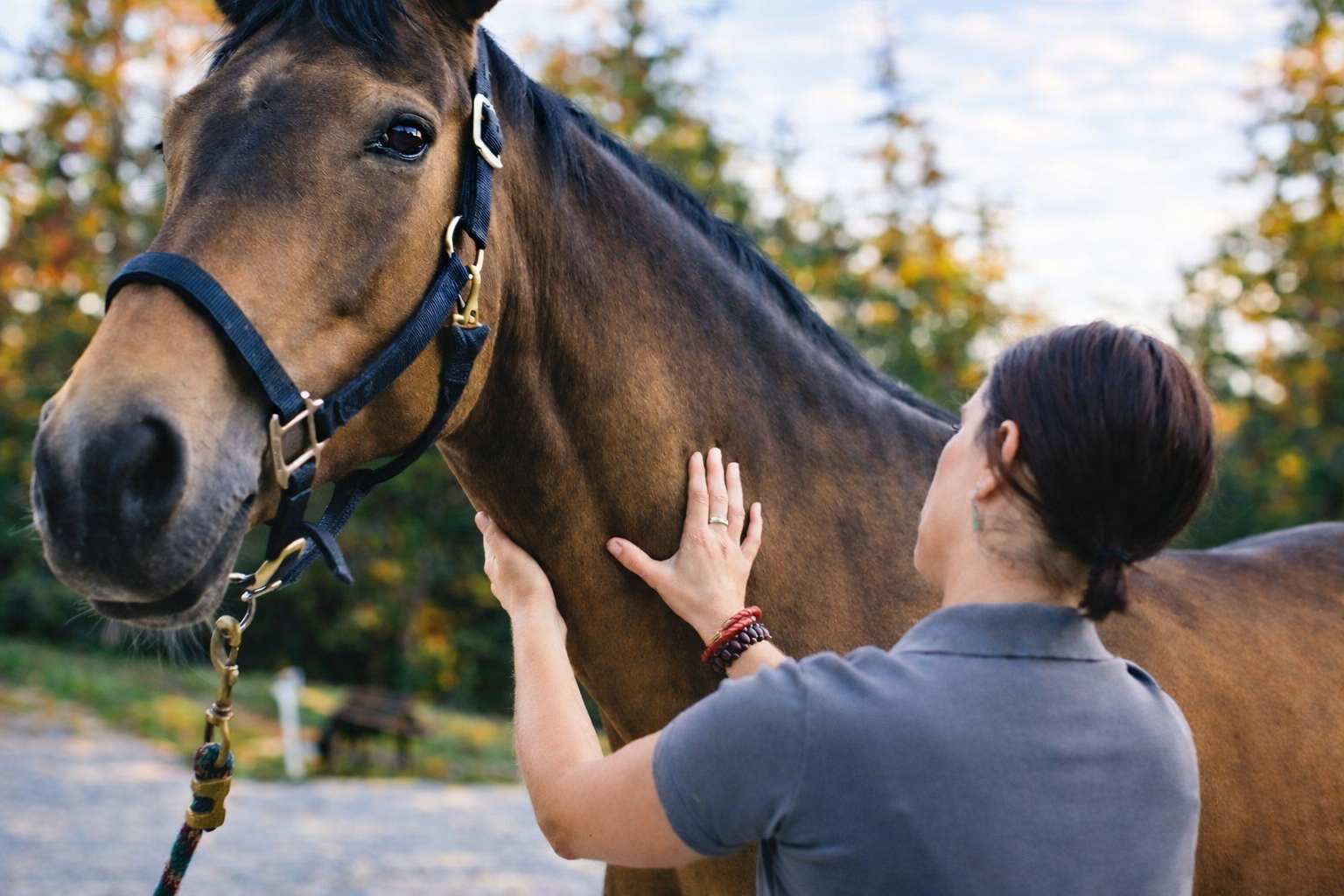
For me, one of the most useful parts of learning bodywork is not simply knowing techniques. It is spending enough time with your hands on your horse that you become familiar with them.
You begin to know that one shoulder normally feels a certain way. You know how your horse typically responds when you work around their neck or back. You notice when an area that is normally comfortable suddenly produces a different response.
That kind of familiarity is difficult to build if the only time we closely examine the horse’s body is when something has already gone wrong.
It is also a large part of why I created Equine Bodywork Online. I wanted horse owners to have a structured way to learn about the major muscle groups, understand what they are feeling beneath their hands, and add simple bodywork to the care they are already providing.
If your horse is consistently stiffer on one side, start by observing rather than immediately trying to correct it. Look at when it happens, what movements bring it out, whether it is changing, and what the rest of the horse is doing at the same time. Those details are often much more useful than simply knowing that the right side feels harder than the left!