
Shoulder Tension in Horses: Signs, Causes, and What Your Horse’s Movement May Be Telling You
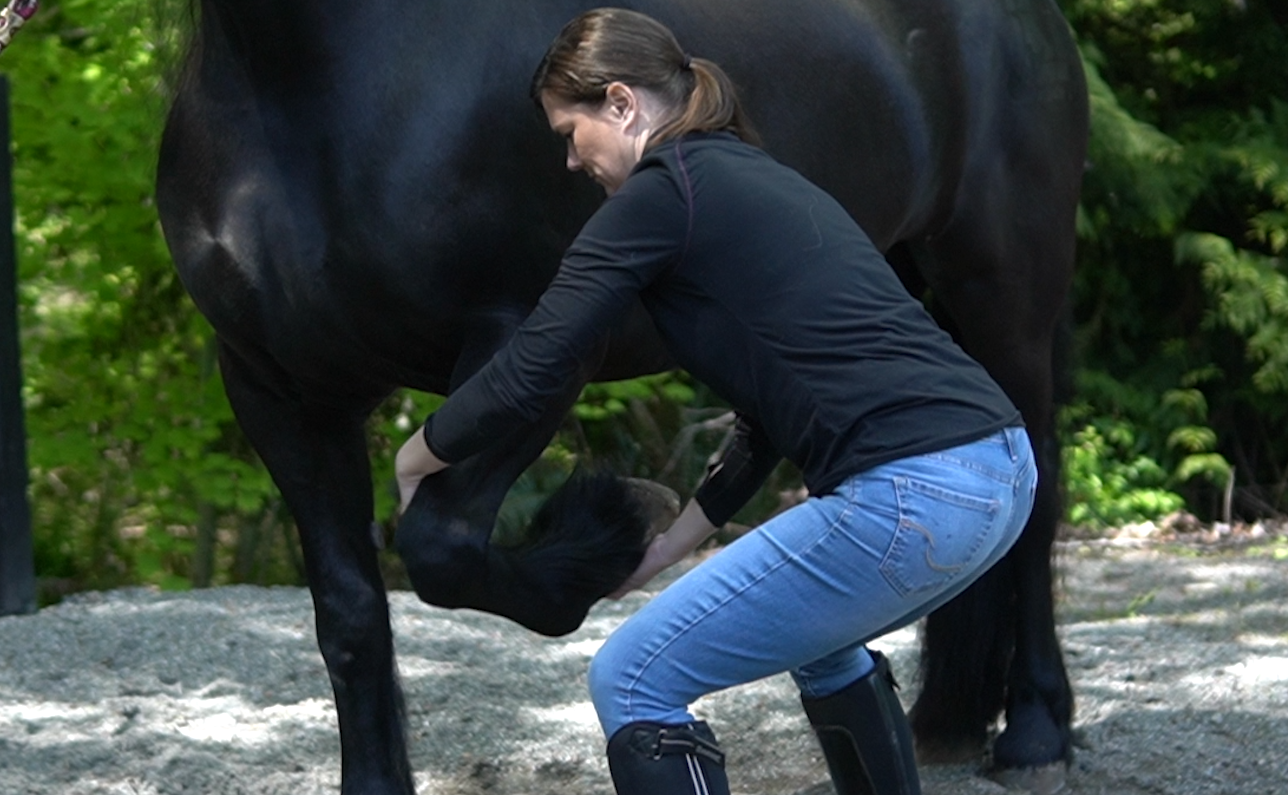
Shoulder tension in horses does not always look like an obviously sore or tight shoulder. You may first notice that one front leg does not reach quite as far as the other. Your horse may feel different turning one direction, fall in through the shoulder on a circle, or become sensitive when you groom around the scapula.
These changes are worth paying attention to, but finding tension does not automatically tell you where the problem started.
Your horse’s shoulder is part of a much larger movement system involving the neck, chest, back, forelimbs, feet, and the muscles that support the entire front of the body. A muscle that feels tight may be the source of discomfort, but it may also be working harder because the horse has changed how they move somewhere else.
That is why one of the most useful things you can do as an owner is learn to look beyond the tight spot.
Do not just find the tension. Follow the pattern.
What Does Shoulder Tension Look Like in Horses?
Shoulder tension may show up as a change in movement, symmetry, comfort with touch, or the way your horse uses one forelimb compared with the other.
You may notice:
One forelimb does not reach forward as freely
One side appears shorter through the stride
Difficulty turning in one direction
Falling inward or outward on a circle
Drifting through one shoulder
Difficulty staying straight
Less freedom through the base of the neck
Sensitivity when grooming around the shoulder or scapula
Repeated skin or muscle twitching when the area is touched
One shoulder appearing more or less developed than the other
Consistently standing with one front foot positioned differently
Changes in willingness during certain exercises or movements
These are observations, not a diagnosis.
A shortened stride, for example, does not automatically mean the horse has a shoulder problem. The change could be muscular, compensatory, or related to another part of the limb or body. What becomes especially useful is noticing when the same change happens repeatedly.
Your Horse’s Shoulder Is Built Differently From Yours
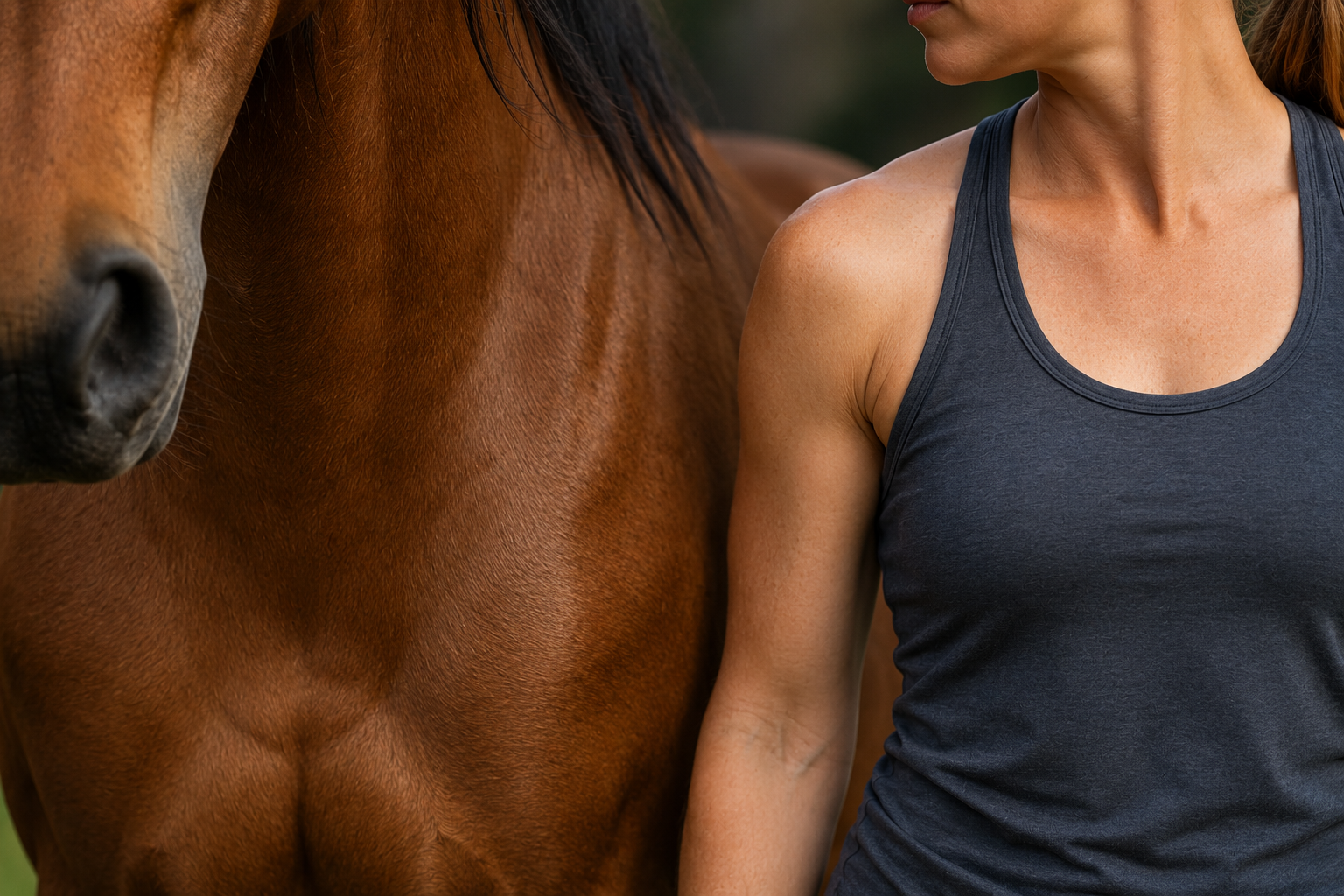
One reason the equine shoulder is so fascinating is that the horse’s front limb is not attached to the trunk by a clavicle the way a human arm is.
Instead, muscles and connective tissues help support the horse’s trunk between the front limbs. This muscular support system is called the thoracic sling.
Think of it almost like the front of the horse’s body being suspended between the forelimbs by muscle. Those muscles have an enormous job. They help support and stabilize the trunk, manage forces as the horse bears weight, position the scapula, and coordinate movement between the forelimbs and the rest of the body.
This is why shoulder health is about much more than the shoulder joint itself.
The Scapula Needs to Move
A healthy shoulder does not simply need strength. The scapula also needs to move smoothly as the horse travels. As your horse walks, trots, turns, climbs hills, performs lateral work, jumps, or lands after a fence, the scapula moves in coordination with the forelimb and trunk. The surrounding muscles have to provide both mobility and stability.
Too little movement is not ideal, but neither is a complete lack of muscular support. The body is constantly balancing movement with control. That is one reason the goal of bodywork should not simply be to find every muscle that feels tight and loosen it. We want to understand how the area is functioning as part of the whole horse.
The Shoulder Is a Team, Not One Muscle
When horse owners talk about “the shoulder,” it is easy to picture one specific area. In reality, many different muscles contribute to how the shoulder and forelimb function. The serratus ventralis is a major part of the thoracic sling. It helps support the trunk between the forelimbs and contributes to stability as the horse accepts weight through the front end.
The trapezius and rhomboideus help position and stabilize the scapula while connecting the shoulder area with the neck, withers, and topline. This is one reason tension through the neck, withers, and shoulder can sometimes appear together. The pectoral muscles help stabilize the forelimbs in relation to the trunk, connecting our shoulder conversation with the chest and girth area.
Other muscles, including the brachiocephalicus and omotransversarius, connect the neck and forelimb and help advance the limb. The latissimus dorsi connects the trunk and back with the upper forelimb and contributes to bringing the limb backward. You do not need to memorize all of these muscles to support your horse.
What is more important is understanding the bigger picture: the shoulder does not work alone.
The Tight Spot May Be Doing a Job
This is where shoulder tension becomes particularly interesting. A muscle that feels tight is not necessarily a muscle that is failing. Sometimes that muscle is tense because it is being asked to do more work.
It may be helping the horse stabilize differently, adjust their balance, respond to altered loading, or compensate for another change in movement. Sometimes the muscle that feels tight is working overtime.
Imagine that a horse begins using one forelimb a little differently. The rest of the body still has to find a way to walk, turn, balance, and carry weight. Muscles around the chest, neck, opposite shoulder, or back may change how much work they are doing to help accomplish that.
That does not tell us why the original change occurred. It simply shows why focusing only on the place that feels tight can leave out important information.
The horse moves as one body.
Why Neck and Shoulder Tension Can Show Up Together
The connection between the neck and forelimb means that changes in one area can sometimes appear alongside changes in the other.
You might notice that the same horse who has less reach through one front leg also feels less free through the base of the neck. Perhaps bending is easier in one direction, or the horse repeatedly reacts when you touch a particular area around the shoulder. Instead of immediately deciding that each observation has a separate cause, look at when and where they appear.
Does the difference happen in both directions? Does it change after the horse warms up? Is it present while the horse is loose as well as under saddle?
Questions like these help you build a better picture without trying to diagnose the horse yourself.
What Can Increase Demand on a Horse’s Shoulders?
Many normal parts of a horse’s life can increase the amount of work required from the shoulder and surrounding muscles.
A change in workload is a good example. A horse coming back into work after winter downtime, moving from three rides a week to five, beginning jump schooling, or increasing trail mileage needs time to adapt to those new demands. Repetitive movement also places repeated demands on the forequarter. Circles, lateral work, jumping, dressage schooling, driving, trails, and other disciplines all require the muscles around the shoulder to repeatedly move and stabilize the body.
Terrain can change those demands again. Hills, uneven trails, mud, hard ground, and irregular footing require constant adjustments in balance and stability. Fatigue may influence movement as well. As muscles become tired, the way the horse coordinates and stabilizes their body can begin to change.
And sometimes the shoulder is responding to something happening elsewhere. Changes in a foot, lower limb, opposite limb, back, or another part of the body can influence how the horse distributes weight and uses the forehand. Tack can also be one piece of the puzzle in a ridden horse. Because the scapula moves during locomotion, repeated sensitivity or movement changes around the shoulder are a reason to consider the entire picture, including how tack interacts with the horse.
None of these automatically “cause” a tight shoulder. They simply help us understand how many different factors can influence this area.
How to Observe Your Horse’s Shoulders at Home
You do not need to diagnose your horse to become a better observer of their body. In fact, observing before intervening can give you far more useful information than immediately trying to change what you find.
Start With Your Horse Standing Naturally
Before touching anything, simply look. Notice where each forelimb is placed and compare the two shoulders. Does one appear more developed? Does your horse consistently stand with one front foot forward or back? A single moment may not tell you much. Look for habits that repeat over time.
Watch Your Horse Walk Straight
Watch your horse walk both toward and away from you. Pay attention to the rhythm and reach of the forelimbs. Does one leg appear to travel differently? Does your horse remain straight, or does part of the body consistently drift to one side? You do not need to decide why something is happening. At this stage, you are gathering information.
Compare Both Directions
If it is safe and appropriate for your horse, observe movement in both directions on a circle. Does one direction look different? Perhaps the horse turns more easily one way, falls through one shoulder, or shows a difference in forelimb reach. Again, resist the urge to label the cause. Note the pattern instead.
Pay Attention During Grooming
Grooming gives you another opportunity to become familiar with your horse’s normal responses. Watch for repeated changes such as moving away, turning toward the area, skin twitching, muscle tension, ear changes, altered breathing, or sensitivity in the same location. One reaction on one day does not necessarily tell you much.
Repeated patterns are far more useful information.
One Shoulder Feels Tighter Than the Other. What Does That Mean?
If one shoulder feels different from the other, the safest conclusion is simply that you have found a difference between the two sides. It does not automatically mean the tighter side is the “bad” side.
That side could be doing more work. It could be doing less. Your horse could be loading the limbs differently, or the difference may simply be part of that horse’s normal body. Instead of immediately trying to fix it, ask a few questions.
Does the difference remain after the horse warms up? Is it more noticeable in one direction? Does one forelimb move differently? Is the change present without a rider? Is this new, or has your horse always felt this way?
Observe first. Interpret carefully.
Where Does Equine Bodywork Fit?
Gentle bodywork can be a valuable way to become more familiar with your horse’s body and provide supportive care when it is appropriate. It can help you learn what your horse normally feels like, compare one side with the other, notice changes over time, explore how your horse responds to touch, and encourage relaxation after appropriate activity.
The goal does not have to be:
Find the knot and get rid of it.
Instead, bodywork can become another form of observation. How does your horse respond? Does the tissue feel different from one side to the other? Does the response change after movement? Is the same area repeatedly sensitive? The more familiar you become with your horse’s normal, the easier it can be to recognize when something changes.
When Shoulder Changes Need More Than Bodywork
Bodywork has an important place in supportive care, but unexplained pain or lameness requires a different approach. True shoulder problems cannot be diagnosed simply by watching a horse move or finding a sensitive muscle. In fact, what looks like a shoulder issue can sometimes originate lower in the limb or elsewhere in the body.
Veterinary evaluation is appropriate if you notice:
Clear lameness
A sudden change following trauma
Significant or persistent shortening of the stride
Swelling or heat
Reluctance to bear weight
Significant muscle wasting
Neurological-looking changes
Increasing asymmetry
Movement changes that persist or continue to return
Bodywork should never be used to work a horse through unexplained lameness.
Don’t Just Find the Tension. Follow the Pattern.
Shoulder tension can give you useful information about your horse, but the tight spot is only one part of the conversation. Watch how your horse stands. Look at their movement. Compare sides. Notice what changes after warming up and what stays the same. Pay attention to repeated responses during grooming and bodywork.
You are learning your horse’s normal, recognizing changes earlier, and becoming more thoughtful about the way their entire body works together. And if you would like a simple way to begin exploring this area with your own horse, start with the free Equine Bodywork Online Shoulder Release.
This guided technique gives you an approachable way to explore the shoulder region, support relaxation, and pay closer attention to the patterns your horse may be showing you!
Frequently Asked Questions About Shoulder Tension in Horses
Can horses get tight shoulders?
Yes. The muscles surrounding and supporting the scapula can carry increased tension or workload. However, muscular tension is different from an injury or painful condition involving the shoulder joint, so persistent movement changes should not automatically be treated as a tight muscle.
What are the signs of shoulder tension in horses?
Possible observations include differences in forelimb reach, difficulty turning or staying straight, changes in muscle symmetry, reduced freedom through the base of the neck, or repeated sensitivity around the shoulder. These observations cannot identify the underlying cause on their own.
Why is my horse taking a shorter stride with one front leg?
A shorter front stride can have many possible explanations, including muscular tension, compensation, or discomfort elsewhere in the limb or body. If the change is clear, persistent, worsening, or accompanied by lameness, veterinary evaluation is appropriate.
Can neck tension affect a horse’s shoulder?
The neck, scapula, and forelimb are connected through several muscles that participate in movement and stabilization. Because these areas work together, changes in neck and shoulder movement may appear at the same time.
Can saddle fit affect shoulder movement?
Tack is one factor worth considering when a ridden horse repeatedly develops sensitivity or altered movement around the shoulder. The scapula moves during locomotion, so the relationship between the horse’s movement and the saddle should be considered as part of the larger picture rather than assumed to be the sole cause.
Can I massage my horse’s tight shoulder?
Gentle supportive bodywork may be appropriate for a comfortable horse, but owners should not attempt to massage away unexplained pain, swelling, acute injury, or lameness. When you are unsure whether a change is simply muscular tension, veterinary evaluation is the safer next step.