
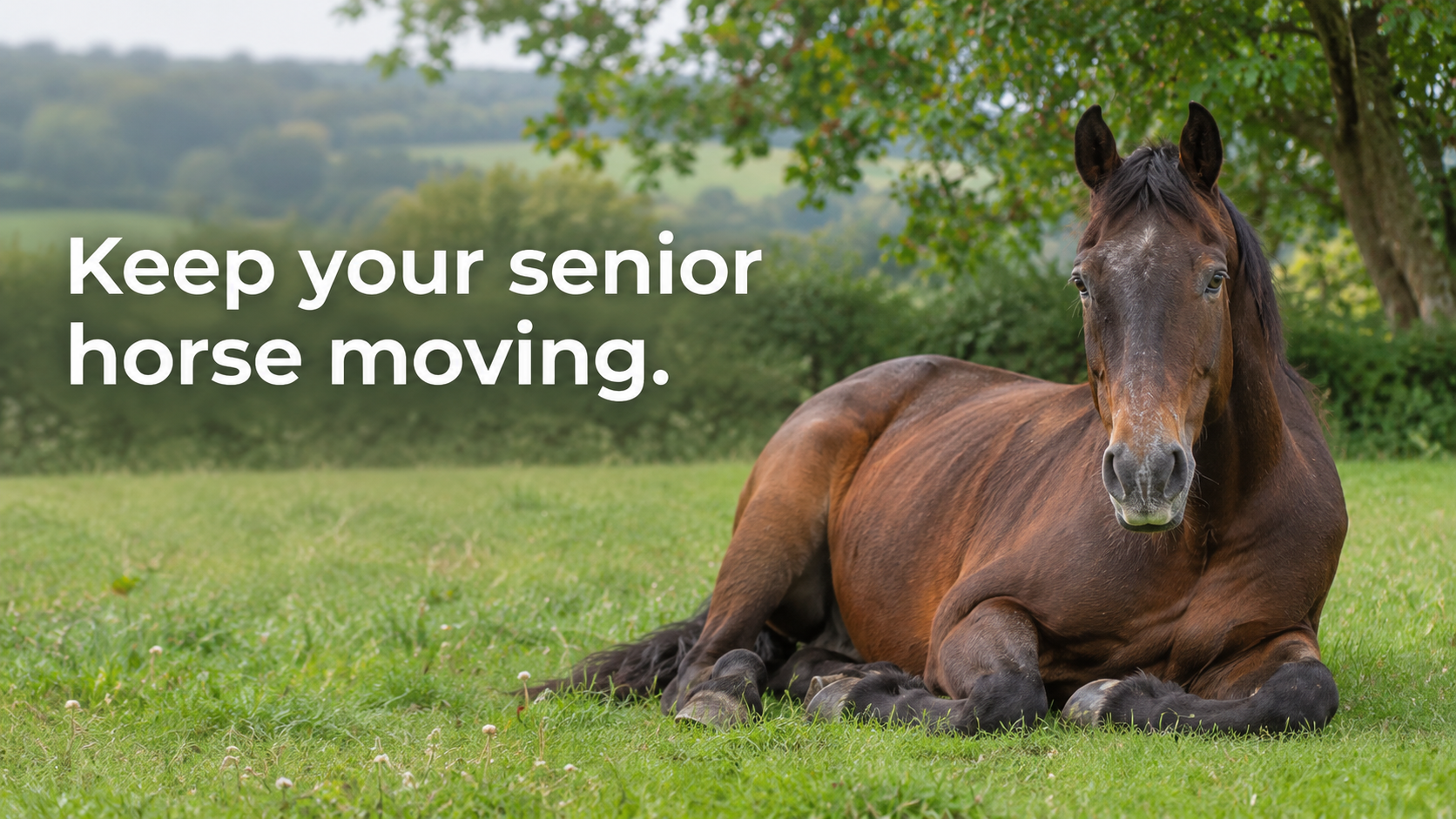
When a horse reaches their late teens or twenties, it's natural to start thinking about how their needs are changing. Maybe they're no longer competing, their workload has become lighter, or they've officially retired from riding. We want to keep them comfortable, protect their joints, and make sure we're not asking too much of an aging body.
One of the most important things we can do for a healthy senior horse is to keep them moving.
While retirement from demanding physical work is sometimes necessary, retiring from regular movement is different. Horses are designed to move, and their muscles, joints, and supporting tissues continue to benefit from appropriate physical activity throughout their lives.
The goal isn't to keep an older horse working at the same intensity they did when they were younger. It's to find a level of movement that supports their changing body, maintains the strength they still have, and helps them remain comfortable and mobile for as long as possible.
What Happens to a Horse's Body as They Age?
Aging affects horses in much the same way it affects other mammals. Over time, changes in muscle mass, joint health, connective tissues, and exercise tolerance begin to influence how comfortably and efficiently they move.
One of the more noticeable changes is a loss of muscle, particularly along the topline and through the hindquarters. You might notice that your horse's back looks less developed, their hind end has lost some of its roundness, or activities that were once easy now require more effort.
This is more than a cosmetic change.
Muscles play an essential role in supporting the skeleton, stabilizing joints, and controlling movement. When muscle mass and strength decline, the horse has less muscular support available for everyday activities such as walking over uneven ground, maintaining balance, and transitioning between gaits.
A study published in the Equine Veterinary Journal examined 2,717 senior horses in the United States and found that 17.2% were reported by their owners to have low muscle mass. Increasing age, osteoarthritis, certain medical conditions, and retirement status were among the factors associated with muscle loss.
The researchers also found that owners frequently associated low muscle mass with reduced working ability and aspects of their horses' welfare.
Importantly, this was an observational survey, so it doesn't establish that retirement itself causes muscle loss. However, it highlights why monitoring muscle condition and maintaining appropriate activity deserve attention as horses age.
Why Movement Is Important for Aging Joints
One of the biggest concerns owners have about exercising an older horse is whether movement will place additional stress on aging joints.
It's a reasonable concern, particularly for horses with a history of arthritis or previous injuries. However, joints are not structures that benefit from complete inactivity simply because they're getting older.
Within many of the horse's joints, articular cartilage covers the ends of the bones, helping distribute forces and allowing the joint surfaces to glide against one another. Synovial fluid provides lubrication and contributes to the environment that supports cartilage health.
Unlike many other tissues, articular cartilage has no direct blood supply. It relies heavily on the surrounding joint environment for nutrient exchange, and normal mechanical loading plays an important role in maintaining joint function.
Research published in The Veterinary Journal explains that exercise influences the balance of processes that maintain healthy joint tissues. Appropriate loading is important, although excessive or poorly managed exercise can also contribute to joint problems.
This is why the conversation around senior horse exercise needs to focus on the right amount and type of movement, rather than simply choosing between exercise and rest.
For a healthy older horse, regular walking, turnout, and controlled low-impact exercise provide opportunities for the joints to move through comfortable ranges of motion.
Even horses with managed arthritis often benefit from consistent light activity as part of a veterinary-directed care plan.
The University of Minnesota Extension specifically recommends daily light exercise or turnout for many senior horses, while emphasizing that both excessive work and complete inactivity can create problems for arthritic joints.
Research: How Exercise Influences Equine Joint Homeostasis — The Veterinary Journal (2017)
Additional Reading: Caring for Your Senior Horse — University of Minnesota Extension
Retirement Doesn't Mean Your Horse No Longer Needs Muscle
We often associate strength training with performance horses, but muscle strength remains important long after a horse's competitive career has ended.
Consider what your horse's body does during an ordinary day. Their hindquarters help propel them forward, their abdominal and back muscles contribute to postural stability, and the muscles surrounding their limbs help control joint movement and balance.
None of those responsibilities disappear when we stop riding.
In fact, maintaining strength becomes especially valuable as horses age because normal age-related changes can make movement more challenging.
A horse who spends much of the day standing in a stall, with little opportunity for purposeful activity, has fewer opportunities to use and maintain those muscles. Over time, reduced activity can contribute to deconditioning, making even simple tasks more physically demanding.
The American Association of Equine Practitioners recommends consistent light exercise for older horses when appropriate, noting that it can support muscle strength and range of motion. Their care guidelines also favor pasture movement over prolonged stall confinement for many geriatric horses.
This doesn't mean every senior horse needs a formal training program. Some will do very well with generous turnout, gentle walks, and occasional groundwork. Others, particularly those who are still sound and accustomed to regular exercise, will benefit from a more structured routine.
The important thing is that we're giving the body a reason to continue using the muscles it needs.
Reference: AAEP Care Guidelines — Caring for the Geriatric Horse
Is Turnout Enough Exercise for a Senior Horse?
Turnout is one of the best ways to provide older horses with opportunities for natural movement. It allows them to walk, change direction, interact with their environment, and move at a pace that feels comfortable.
For some senior horses, particularly those with significant physical limitations, turnout may provide most or all of the movement they need.
However, being turned out doesn't necessarily mean a horse is moving very much.
A 2026 observational study followed 28 senior sport horses between 17 and 35 years old, measuring their movement during two-hour paddock turnout sessions. Researchers found that older horses generally traveled shorter distances and moved more slowly than younger horses within the senior group.
The study was relatively small and couldn't establish how individual horses changed over time. Still, it raises an interesting point for owners: access to turnout and actual daily movement are not necessarily the same thing.
If your older horse spends much of their turnout time standing near the hay feeder, you might consider whether a little additional walking or gentle groundwork would be appropriate.
A short walk around the property, an easy in-hand session, or a few carefully selected exercises can introduce movement without requiring a return to regular ridden work.
Research: Age-Associated Differences in Paddock Locomotor Activity Among Senior Horses — Animals (2026)
The Best Exercises for Senior Horses
The most useful exercise routine for an older horse is one that matches their current health, physical condition, and previous activity level.
For healthy senior horses, consistency and controlled movement are generally more valuable than occasional strenuous workouts.
1. Walking to Maintain Mobility
Walking is an excellent foundation for senior horse exercise because it encourages movement through the limbs and back without the higher forces associated with faster gaits.
It also gives you an opportunity to observe how your horse is moving.
Pay attention to their stride length, rhythm, willingness to move forward, and ability to turn comfortably in both directions. If they appear stiff at the beginning of a session, allow extra time for a gentle warm-up rather than immediately asking for more demanding movements.
Short, regular walks are often a practical starting point for an older horse who is no longer in consistent work.
2. Ground Poles for Coordination and Strength
Ground poles introduce a little more purpose to an ordinary walk.
When a horse approaches a pole, they need to judge its position, organize their foot placement, and coordinate their limbs to step over it. This introduces a different movement challenge than walking on an uninterrupted flat surface.
For an older horse who is healthy and comfortable enough for pole work, appropriately spaced flat poles can be a useful way to practice coordination, balance, and controlled limb movement.
The emphasis should remain on quality rather than quantity. Start with a single flat pole, allow your horse to approach at a relaxed walk, and watch how comfortably they negotiate the exercise.
Raised poles, complicated patterns, and repeated tight turns aren't necessary to make a session productive. These add demands that may not be suitable for every senior horse.
3. Gentle Hills for Muscular Engagement
Walking on a mild incline changes the demands placed on the horse's body and encourages the muscles involved in propulsion and postural control to work differently than they do on level ground.
For a conditioned senior horse, gentle hills can add useful variety to a walking routine.
Choose safe, consistent footing and introduce inclines gradually. Horses with joint discomfort, weakness, or balance difficulties may find hills challenging, so they should only be included when appropriate for the individual.
4. Simple Groundwork for Body Awareness
Groundwork doesn't need to involve complicated exercises to be beneficial.
Walking straight lines, making large gradual turns, practicing controlled transitions, and moving over different safe surfaces all provide opportunities for the horse to coordinate their body.
These activities also allow you to observe small changes in how your horse moves. You may notice that one direction is more difficult, that they take shorter steps than usual, or that they become tired sooner than expected.
Those observations are useful information when deciding how to adjust their routine or whether veterinary assessment is needed.
How Much Exercise Does a Senior Horse Need?
There isn't one exercise schedule that works for every older horse.
A healthy 19-year-old horse who has been in consistent work will have very different needs from a 30-year-old retiree with a history of arthritis or metabolic disease.
Previous fitness, current muscle condition, hoof health, underlying medical conditions, and the horse's response to exercise all influence what is appropriate.
For horses who have been inactive, begin with brief, comfortable sessions and gradually increase the amount of work as their tolerance and conditioning improve. A veterinarian can help determine a safe starting point, particularly when a horse has existing health concerns.
It's also worth remembering that older horses often need longer warm-up and cool-down periods. Allowing them time to settle into their movement is a simple adjustment that respects the changes taking place in their bodies.
Watch how your horse feels both during and after exercise. Persistent stiffness, new swelling, shortened strides, reluctance to move, lameness, or unusual fatigue should prompt you to stop and seek veterinary guidance.
Exercise should support your horse's comfort and function, not become something they have to struggle through.
Supporting Senior Horses Through the Winter Months
Cold weather often brings changes to a horse's daily routine. Turnout hours become shorter, footing conditions change, and some horses spend more time standing inside than they do during warmer months.
For senior horses, this reduction in activity deserves particular attention.
A horse who was walking around a large pasture throughout the summer may suddenly have fewer opportunities to move. If they're already experiencing age-related muscle loss or joint stiffness, that change in routine can make maintaining mobility more difficult.
This is a good time to think about how you can preserve consistent movement without asking too much of their body.
On days when conditions are safe, a short in-hand walk, a gentle groundwork session, or a few minutes of flat pole work can help maintain a regular activity routine.
The British Horse Society also recommends increasing turnout opportunities where possible and incorporating in-hand walking for retired horses whose movement becomes restricted during winter.
Of course, icy ground, deep mud, extreme weather, and unsafe footing are reasons to modify or skip an exercise session. A healthy movement routine should always account for the conditions your horse is working in.
Reference: Care of Elderly Horses — British Horse Society
Helping Your Senior Horse Stay Strong for the Years Ahead
One of the most rewarding parts of caring for a senior horse is finding ways to adapt their routine as their needs change.
The horse who once spent their weekends competing may now enjoy quiet walks around the property. Another might still love a gentle ride, while a fully retired horse enjoys a few minutes of purposeful groundwork.
All of these activities have value when they're appropriate for the individual horse.
Research and veterinary guidance consistently support the importance of maintaining suitable physical activity in healthy older horses. Movement contributes to joint function, muscular conditioning, and the ability to continue performing everyday activities comfortably.
And while we can't stop the aging process, we can be thoughtful about how we support our horses through it.
Rather than looking at an older horse and asking what they should stop doing, it's worth considering what types of movement they can comfortably continue enjoying.
Give Your Senior Horse a Purposeful Movement Routine
If you've been looking for a simple way to keep your older horse active without overwhelming them, our Senior Horse 4-Week Workout Plan is designed to help you bring more purposeful movement into their routine.
With guided exercises focused on strength, balance, coordination, and mobility, you'll have a structured way to make the most of your time together while respecting your horse's individual abilities.
Whether your horse is enjoying a lighter workload or has retired from riding, thoughtful movement remains an important part of supporting their long-term comfort.
Explore the Senior Horse 4-Week Workout Plan and help your horse keep moving through their golden years.
Always consult your veterinarian before beginning a new exercise program with an older horse, particularly if they have arthritis, lameness, a history of injury, or another medical condition. Horses on prescribed rest should not exercise until cleared by their veterinarian.